Coordination Is Learned One Repetition at a Time
Coordination practice gets clearer with focused repetitions, useful feedback and manageable variation, so you can choose an approach that fits the movement.
Your foot catches the curb as you turn to answer a friend. The next time, you slow down, look ahead and step cleanly onto the sidewalk. That small adjustment is coordination practice: a clear movement, a chance to notice what happened, and another attempt.
Coordination practice does not require a special gift or a complicated routine. Choose a movement, focus on one useful detail, and adjust the task when it becomes unclear. The best practice format depends on whether you are learning a pattern, adapting it or organizing a sequence.
Coordination practice can repeat one movement or vary it
Repetition gives a movement a steady shape. You might practise a gentle squat, a tennis serve toss or a step-up using the same setup each time. With the surroundings held steady, you can notice balance, timing or where the movement begins.
Variation changes one feature while keeping the basic task recognizable. For a step-up, that could mean changing the lead leg or approaching from a different angle. Your body has to adjust instead of replaying exactly the same sequence.
Neither approach is always better. Repeat one version when the pattern is new or confusing. Introduce variation when you can recognize the movement and want to adapt it. If several details change at once, it can be hard to tell what made the movement clearer or less controlled.
Begin with a stable version. Change one detail only when the movement remains clear and comfortable.
One useful cue makes feedback easier to use
Feedback is information about what happened during a repetition. It might come from a coach, a mirror, the feel of your balance or the sound of your shoes on the floor. Several corrections at once can crowd your attention, so choose one cue that relates to the task.
During a slow lunge, notice whether your front foot stays grounded. During a dance step, listen for the beat. A mirror can show where your hand travels, but it cannot explain every sensation or reveal what a movement feels like from the inside.
External feedback can help when you are unsure what happened. Internal feedback—the body's sense of pressure, position and timing—can help you recognize a pattern without constant prompts. Treat both as useful information, not perfect judges.
Say you are learning to toss a soft ball into a bucket and keep missing to the left. For your next attempt, focus on releasing the ball in front of your shoulder rather than changing your stance, grip and speed together. If the ball travels closer to the bucket, that gives you a specific detail to keep or adjust.
Three practice formats answer different questions
Blocked practice repeats one movement in a row: the same reach, step or throw, with a pause between attempts. It can suit someone who needs time to understand a new pattern or wants a calm setting with few surprises. A movement that feels polished in one setup may still need practice in other settings.
Variable practice mixes related versions of a movement. You might reach to different comfortable heights or alternate between stepping forward and sideways. This can suit someone who recognizes the basic pattern and wants to adjust it. Keep the variations close enough that you can still identify what the movements have in common.
Mental rehearsal means picturing or quietly planning a movement before doing it. It can help you organize a sequence when space is limited or prepare for a physical attempt. It does not provide the sensory information of moving, so pair it with actual practice when that is possible.
Choose the format that answers your current question: repeat one version if the movement is unclear, vary a familiar pattern if you want to adapt it, or rehearse the sequence before trying it.
How should you adjust a coordination session?
How many repetitions should I practise?
There is no single useful count for every movement. Pause when attention fades or the movement becomes noticeably less controlled; continue only if you can still notice what each attempt teaches.
Should I practise slowly or at full speed?
A slower pace can make timing and position easier to notice while you learn a movement. Add speed only when you can stay attentive and move comfortably.
What should I do when a repetition feels awkward?
Pause and simplify one part of the task, such as its range, pace or number of connected actions. If discomfort or uncertainty persists, choose another activity or seek guidance from a qualified coach or clinician.
How do I know when to add variation?
Add one modest change when the familiar version feels understandable rather than accidental. If the movement becomes confusing, return to the simpler version and build from there.
A short decision list can shape your next attempt
Name the movement and the question you want to answer before you begin. “Can I keep my balance as I step?” gives your attention a clear job. “Can I get better?” does not point to a specific detail.
- Check: Is the basic movement unclear? If yes, repeat one stable version; if no, keep the familiar pattern and consider changing one detail.
- Check: Can you identify one cue, such as a steady foot or relaxed shoulder? If yes, use that cue; if no, simplify the movement or ask a qualified coach for help.
- Check: Does a pause help you notice what happened? If yes, pause between attempts; if no, continue at a comfortable pace while keeping attention on the same cue.
- Check: Does the familiar version feel understandable? If yes, change one feature; if no, return to the stable version before adding variation.
- Check: Does the variation make the movement hard to follow? If yes, remove that change; if no, keep the variation and observe the same cue.
- Check: Is your attention fading or control becoming less clear? If yes, pause or finish the session; if no, continue while you can describe the movement you are practising.
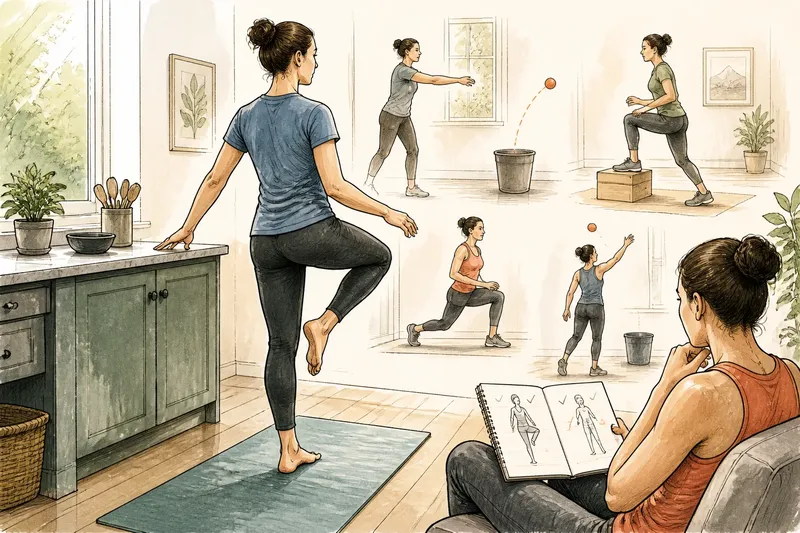
Imagine you are learning to balance on one foot beside a sturdy counter. You begin with a light fingertip nearby and watch whether your standing foot stays planted. When that feels understandable, you turn your head slightly while keeping the same setup and cue. If your balance becomes uncertain, you stop the turn and return to the original position. The result is a clear decision: keep the familiar version for now, or continue with the small change if the movement remains controlled.
Coordination practice gets clearer when each attempt has a purpose. Keep the question simple, use one cue, and let the next repetition tell you whether to repeat, adjust or pause.