The Full-Kit Fallacy: Start by Naming the Task
The full-kit fallacy starts with buying before defining the job. Name your training task first to choose useful equipment and avoid redundant gear.
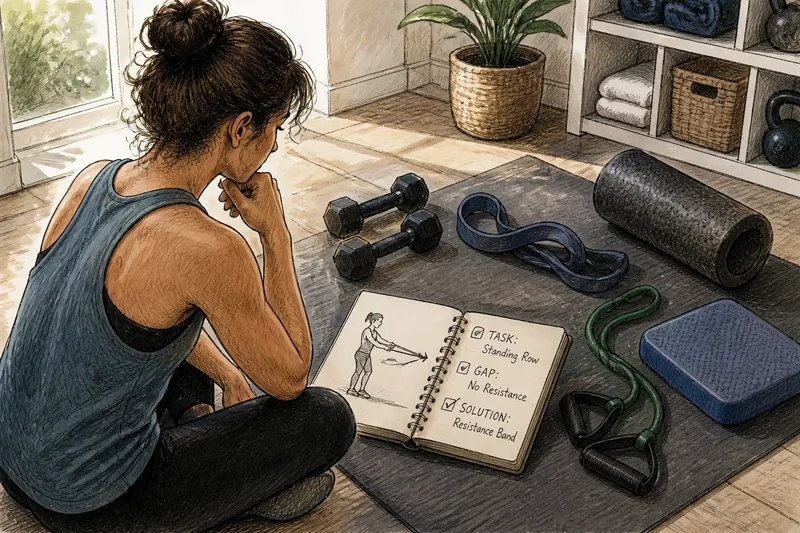
You set out a mat, a pair of dumbbells, resistance bands, a foam roller and a balance pad, then pause before your first movement. The full-kit fallacy begins right there: treating more specialised equipment as automatically more useful, before asking what the session needs. Name the task first, and each item has to earn its place.
Start with the job, not the gear
“I want to get fitter” is a fine reason to move, but it is too broad to guide an equipment choice. A useful task is narrower and observable: practise controlled squats, add resistance to a row, or make a floor exercise more comfortable. The equipment is there to support that task, not to turn a general intention into a shopping list.
Try describing the movement, the challenge you want to change and the feature of a tool that might help. For instance: “I want to practise a standing row; my current setup has no resistance; a band could provide a pull.” That description gives the band a specific job. It also makes clear that a balance pad, massage ball or extra set of weights has no role in that particular gap.
Say you have a mat and a pair of light dumbbells, and want to make a home session more challenging. If the task is to add resistance to a row, you might consider a band that can be used for that movement, then see whether it suits your available anchor point and space. The expected observable result is simple: the row now includes resistance that was absent before. It is not a reason to add unrelated gear.
When equipment stays unused, the job may be vague
A specialised item often arrives with a promise of possibility: a new surface, grip, angle or mode of resistance. But “this might be useful” does not tell you when to take it out, what to do with it or how to judge whether it helped. The result is equipment that lives in a corner because it has no assigned place in a real session.
Give an item a cue tied to an existing activity. A mat may be used for floor-based mobility; a band may be reserved for a particular pulling movement; a sturdy chair may provide support for a standing balance practice. The cue should be clear enough that you can answer, “What task does this help me do?” without listing every possible use.
If you cannot name a movement or session where the item belongs, wait before adding it. A vague future intention is not yet a task.
When a tool duplicates another, compare the job
Two pieces of equipment can look different and still solve the same problem. Bands, dumbbells and weight machines all provide resistance, though their feel, setup and range of uses differ. A new option may be worthwhile if it addresses a specific limitation; it is not automatically worthwhile because it is more specialised.
Compare tools by asking what changes in the task. Does one make a movement easier to set up in your room? Does another offer resistance you can adjust in a way that fits your intended exercise? Is the difference meaningful to the sessions you actually do, rather than to a hypothetical routine you might someday begin?
Imagine a person already uses dumbbells for rows and considers buying a band set. If their named task is a row, the question is not which tool sounds more versatile. It is whether the band would let them perform a version of the row that fits their space or training preference. If no practical difference matters to that person, the existing dumbbells may already do the job.
When setup becomes a barrier, the task may be too costly
Equipment has a setup cost in time, attention and room. A tool can be effective for a movement and still be a poor fit if getting it ready makes the session harder to start. That friction matters most when the item requires a storage shuffle, an awkward anchor or a configuration you have to remember.
Consider the whole path from storage to use. Can you reach the item easily? Is there a clear place to use it? Does the setup suit the exercise you intend to do? A compact tool that is ready when needed may serve a task better than a specialised option that repeatedly interrupts the session.
Keep the task small enough to begin. If setting up an item feels like its own project, look for a simpler way to support the same movement before adding more equipment.
When gear feels unsuitable, check the task and the fit
Sometimes an item is present but does not feel right for the movement. A band may be too difficult to control for the intended exercise; a mat may shift on the floor; a grip may feel uncomfortable. That does not prove that more specialised equipment is needed. First ask whether the tool is being used for the job it can reasonably serve.
Look at the movement, the available adjustment and the fit between the tool and the user. A different grip, resistance level or position may change the experience, if the equipment is designed to allow that adjustment. For anything involving safe use, follow the manufacturer’s instructions and applicable local guidance; ask a qualified professional when your situation calls for individual advice.
Do not force a tool to solve a problem it was not designed for. If discomfort or uncertainty persists, pause that use and choose a more suitable option with appropriate guidance.
How can you tell whether another item has a real job?
What should I name before shopping?
Name the movement or session you want to support, then identify what is missing from the current setup. “A band for a standing row” is more useful than “something for strength.”
Is multifunctional equipment always a better choice?
Not necessarily. A tool with many possible uses earns its place only if those uses match the tasks you intend to do and its setup suits your space.
Should I replace an item that feels awkward?
First check whether the item suits the movement and whether its intended adjustments are being used appropriately. If it remains uncomfortable or confusing, stop using it for that task and seek suitable guidance where needed.
What if I cannot decide whether I need the addition?
Delay the purchase until you can name the task and the observable change you expect the item to support. If the answer stays vague, the need is not yet clear.
Make the decision in a useful order
When a new piece of equipment catches your eye, work through the decision in sequence:
- Name the task. State the movement or session in plain language.
- Identify the gap. Say what the current setup does not provide.
- Match a feature to the gap. Look for the relevant resistance, support, surface or other function.
- Check the setting. Consider the room, storage and setup the task requires.
- Compare what you already own. Decide whether an existing item can serve the same purpose.
- Choose only if the difference is useful. Be specific about what the addition changes in the task.
This order turns equipment shopping into a decision about fit, not possibility. It also leaves room to discover that the best choice is to use what is already available.
Let the task set the size of the kit
A coherent kit does not need to cover every kind of exercise. It needs to support the activities you have chosen, in the place where you do them, without making those activities harder to start. One mat and a set of weights can be a complete setup for someone’s current tasks; another person may need different tools for different movements.
Revisit the job when your routine changes. A new goal may create a real gap, while an old item may no longer serve a regular task. The full-kit fallacy is not owning several things; it is treating extra equipment as progress without naming what it helps you do.
Before adding anything, say the task out loud and point to the feature that would support it. If both are clear, you have a reason to consider the item. If not, give the decision more time.