Before the Fitness Tracker: A Short History of Counting Exercise
Counting exercise can make movement easier to notice. Compare paper logs, pedometers, and wearables to choose a record that fits the question you have.
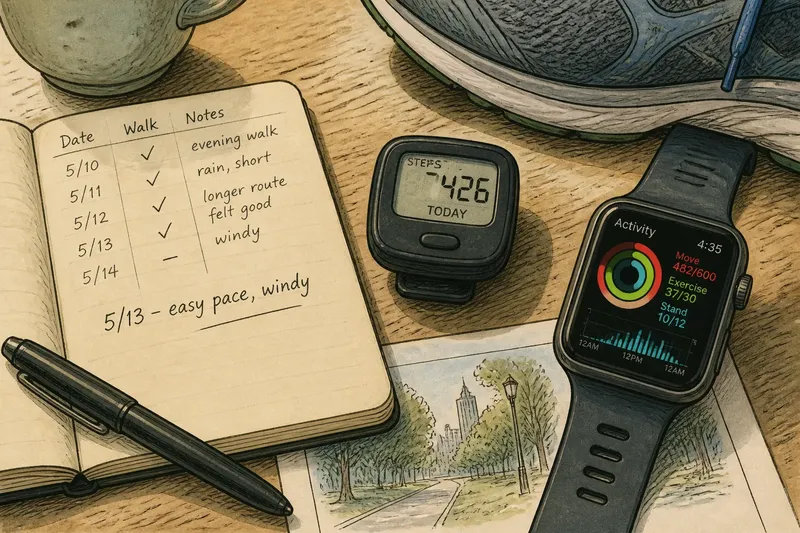
A runner reaches the front door after a neighborhood loop, pauses, and writes “easy pace, windy” in a pocket notebook. That small note is one way to count exercise: it records a chosen detail rather than trying to capture every movement. Paper logs, pedometers, and wearables each make different parts of activity visible.
The shift from informal records to digital trackers is not simply a march toward more accurate numbers. Each tool asks its user to notice something different. Looking at those differences helps explain what a count can tell you—and what it leaves out.
Paper exercise logs let people choose what to record
A diary or training notebook can hold a date, route, elapsed time, or note about how a session felt. There is no required unit. One person might track distance; another might write “walk after dinner” and leave the rest blank.
That flexibility makes context easy to preserve. A note can mention rain, a changed route, or a hill that felt harder than usual. But a paper record depends on memory and the habit of writing things down. Blank entries can make comparisons difficult, and the writer decides which activity is worth recording.
Use a notebook when the details you care about do not fit neatly into a total.
Pedometers made walking countable as it happened
A pedometer registers repeated movement as steps, usually while clipped to clothing or carried close to the body. Instead of recalling a walk afterward, someone can check whether movement has accumulated during the day.
That count is simple, but it is not a complete description of a walk. A device can miss movement depending on how it is worn or how the body moves. Steps also say little about effort: a slow stroll and a brisk climb can both add to the total.
Say someone often forgets a short lunch walk by evening. A pedometer could make those steps visible before the day ends, prompting the person to notice that the walk happened. The count serves as a memory aid, not a verdict on whether the activity was enough.
Digital counters turned exercise records into ongoing displays
As counters appeared in watches and other compact electronics, people could see a running tally and review stored records across days. Activity became something to check during a commute or before dinner, rather than something recorded only after a session.
Some devices added estimates such as distance, active time, or energy use. Those extra figures may offer useful context, but they rely on sensors and assumptions about the wearer. A precise-looking display is not the same as a complete account of movement.
Apps and watches can also emphasize goals, streaks, or progress rings. Those displays make some patterns more noticeable than others. A consistent daily goal, for example, gives regularity visual weight even when a person’s planned sessions vary.
Wearables bring everyday movement into the same record
Many trackers monitor movement throughout the day, not just during a named workout. A walk to a bus, a flight of stairs, and a planned run may appear in one activity record. This can help someone notice movement outside the gym, but it can also blur the difference between an errand and a training session.
Ask which question you want the record to answer. “How much did I move?” is different from “Did I complete the session I planned?” A daily total may help with the first; notes about a session and perceived effort may be more useful for the second.
Shared challenges and leaderboards add another layer. A private count can become a comparison with friends, which may feel encouraging to some people and distracting to others. Choose whether you want that social feature before treating its rankings as meaningful.
What can a count tell you about exercise?
Can a step count describe workout intensity?
Not by itself. Steps show repeated movement, but they do not explain how hard a person worked or whether the session matched its purpose. A short note about effort can add that context.
Are handwritten logs still useful?
Yes, when the details that matter are personal or specific. A note such as “steady pace, legs felt fresh” can say more about a session than a total, and paper works for people who prefer not to consult an app.
Why can tracker totals differ?
Devices can use different sensors, placements, and rules for interpreting movement, so their counts may not match. Treat a total as a reference within the same setup rather than a perfect measure for comparing devices.
Should everyday movement count toward an exercise goal?
That depends on what the goal is meant to support. Including everyday movement can show a fuller picture of an active day, while a training goal may call for a separate record of planned sessions and how they felt.
Choose a way to count exercise that fits your question
Imagine you want to remember whether you took an evening walk, but distance and pace do not matter to you. You start with a pocket notebook and write the date plus a mark after each walk. If you later notice that you often forget to make the entry, you could switch to a phone reminder; if you remember reliably, the notebook keeps the record simple. The result is a record suited to the question—whether the walk happened—without extra estimates.
Counting exercise always involves a choice about what deserves attention. A wearable can make that choice feel automatic, but you can still decide which details matter. Before checking a total, ask what you want it to help you notice.