A Movement Break Between Screen Tasks
A movement break between screen tasks can make desk days feel less fixed: choose a cue, pick a simple change of position, and stop at a clear point.
You finish a video call, close the meeting window, and see the next document waiting. Before opening it, you stand, shift your weight, and take a few steps to refill your water. That small pause is a movement break between screen tasks: not a workout hiding in your calendar, but a deliberate change of position with a clear beginning and end.
The useful planning question is not how much exercise you can squeeze in. It is where a brief change fits without making your workday harder to manage. A cue helps you remember; a stopping point keeps the pause modest. Set those two pieces up once, then let the routine adapt to the shape of the day.
Build the break around a task transition
Desk work already has natural seams. A call ends. A draft is sent. You finish reviewing a page and need to open another file. Those transitions are easier to notice than an alarm that rings in the middle of a thought, so use one as the cue.
Choose a cue that occurs often enough to be useful but not so often that it becomes noise. “After my last scheduled call before lunch” may be clearer than “every time I send an email.” A cue should point to a moment you can actually act on, not another obligation layered over a busy stretch.
Pair the cue with a simple action you can do where you are: stand and sit again, walk to the window and back, or reach your arms overhead while you wait for a file to load. The purpose is to change position and interrupt stillness, not to collect a prescribed number of movements.
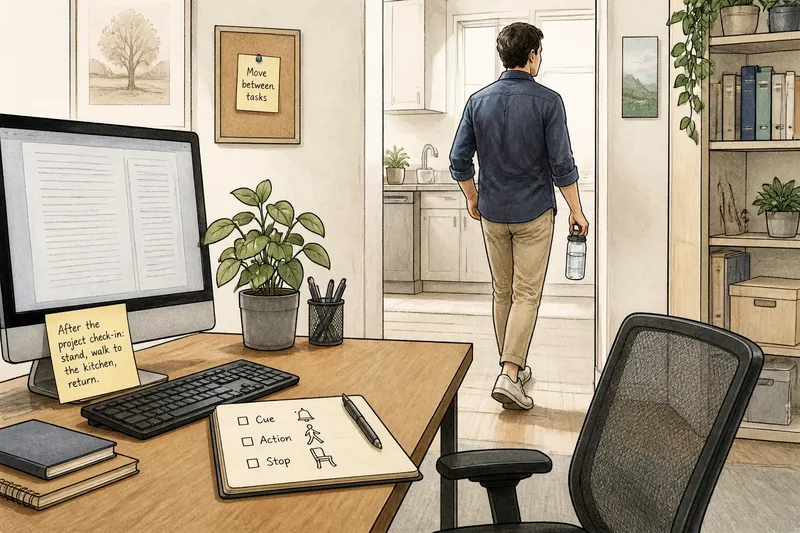
Keep the plan visible in a low-friction way. A note beside your monitor can say, “After the project check-in: stand, walk to the kitchen, return.” You do not need a special app, wearable, or timer if a written reminder and the task transition already do the job.
Use a cue, an action, and a stopping point
A reliable break has three parts: the event that reminds you, the movement you choose, and the signal that tells you it is done. The stopping point matters because “move for a while” can feel vague. A destination, a natural pause, or the return to your chair makes the plan easier to complete without turning it into a workout target.
For example, say you work through a morning of editing and often move straight from one document to the next. You decide that closing a finished draft is the cue. You stand, walk to the office doorway and back, then sit when you reach your desk. The expected observable result is a short change of posture between documents, with the work surface ready for the next task.
That route is only one option. If leaving the room would interrupt concentration, stand beside the desk and gently shift your weight until you feel ready to resume. If standing is uncomfortable or unsuitable, choose a seated change such as moving your feet, extending your legs within a comfortable range, or adjusting your position. Adapt the movement to your body and workspace.
Make the stopping point concrete, not competitive. “Return when I reach the doorway” is easier to judge than “keep going until I feel energized.” You are allowed to feel no dramatic difference. The routine succeeds as a planning habit when the pause is easy to recognize and easy to end.
Give the routine a realistic shape across the week
A small weekly plan can prevent an ambitious schedule from collapsing on the first busy day. Start by noticing where your screen tasks naturally change, then choose one or two transitions that are usually calm enough for a pause. You are not trying to cover every hour or create a perfect record.
- At the start of the week: Identify a dependable transition, such as finishing the first scheduled call or closing a completed work item.
- On a typical workday: Use that cue for one brief change of position, then return to the next task.
- On a meeting-heavy day: Pick a transition that does not require leaving the room, such as standing during a natural pause between calls.
- On a focused-work day: Tie the break to a completed section or saved draft rather than interrupting a concentration block.
- At the end of the week: Keep the cue if it was easy to notice; change it if it repeatedly arrived at an awkward moment.
This plan leaves room for different days without requiring a new system each morning. If a cue lands during a deadline or a call runs late, skip that instance or move the pause to the next natural transition. Missing a break is not a debt to repay with a longer or harder one.
For a hybrid schedule, choose a version that travels. At home, the action might be a walk to the kitchen and back. In a shared office, it could be standing beside the desk or walking to a nearby water station when convenient. Keep the cue consistent if that helps; let the route change with the setting.
Keep movement comfortable and interruption-free
A movement break should fit the space and your current comfort. Leave a clear path before walking, avoid moving into a crowded area, and choose motions that feel controlled rather than rushed. If standing or walking does not suit you, a seated position change can still provide a pause from the same posture.
There is no need to use the break to stretch deeply, chase a burn, or make up for missed exercise. A few easy steps or a comfortable reach may be enough to create a distinct transition. If a movement causes pain, stop and choose a different position or activity; persistent concerns are a good reason to consult a qualified health professional.
Protect attention as well as comfort. A break can be as simple as looking away from the screen while you stand, then returning to the task. If your job requires close monitoring or you are in a live conversation, wait for a safe pause instead of forcing movement at the cue’s exact moment.
When workplace access, a mobility need, or a particular health condition changes what feels appropriate, adapt the plan to your circumstances. General movement ideas are not a substitute for individual guidance where that matters.
What should you do when the day changes?
What if I forget the cue?
Use the next transition you notice rather than trying to recreate the missed moment. If forgetting becomes a pattern, attach the cue to a more visible event, such as closing a meeting window or saving a finished file.
Should a movement break have a fixed duration?
It can have a natural endpoint without a timed target. A short walk to a nearby destination or a change of position followed by a return to work keeps the pause bounded while leaving room for the task and setting.
What if I cannot leave my desk?
Choose a comfortable movement that works in place, such as standing beside the chair or changing your seated position. If neither option fits, pause the screen task and look away briefly when the work allows.
Can I use the same break all week?
Yes, if the cue and action remain convenient. Keep the basic plan steady and change only what is getting in the way, such as using a seated option on a day when walking is impractical.
Make the plan easy to resume
The best movement break between screen tasks is not the one with the most elaborate sequence. It is the one you can recognize, adapt, and finish without bargaining with yourself. A cue tied to a real task transition gives the pause a place in the day; a clear stopping point keeps it from competing with work.
Write a one-line version where you will see it: “After I finish the morning review, stand, walk to the doorway and return.” Try that plan through an ordinary week, not as a test of discipline but as a way to notice whether the cue fits. If it does not, move it to a calmer transition or make the action simpler. The routine should serve the day you actually have.